NOTE: This article published in our Winter Magazine was written before U.S. Delta Force captured Nicolàs Maduro in a Jan. 3 operation. The conflict in Venezuela is a developing story.
For months, the Trump Administration has been fueling tensions in and around Venezuela, an oil-rich country in South America. This has been in an effort by Washington to put pressure on the administration of Venezuelan president Nicolás Maduro, whom Trump blamed for facilitating drug trafficking into the US and European Union.
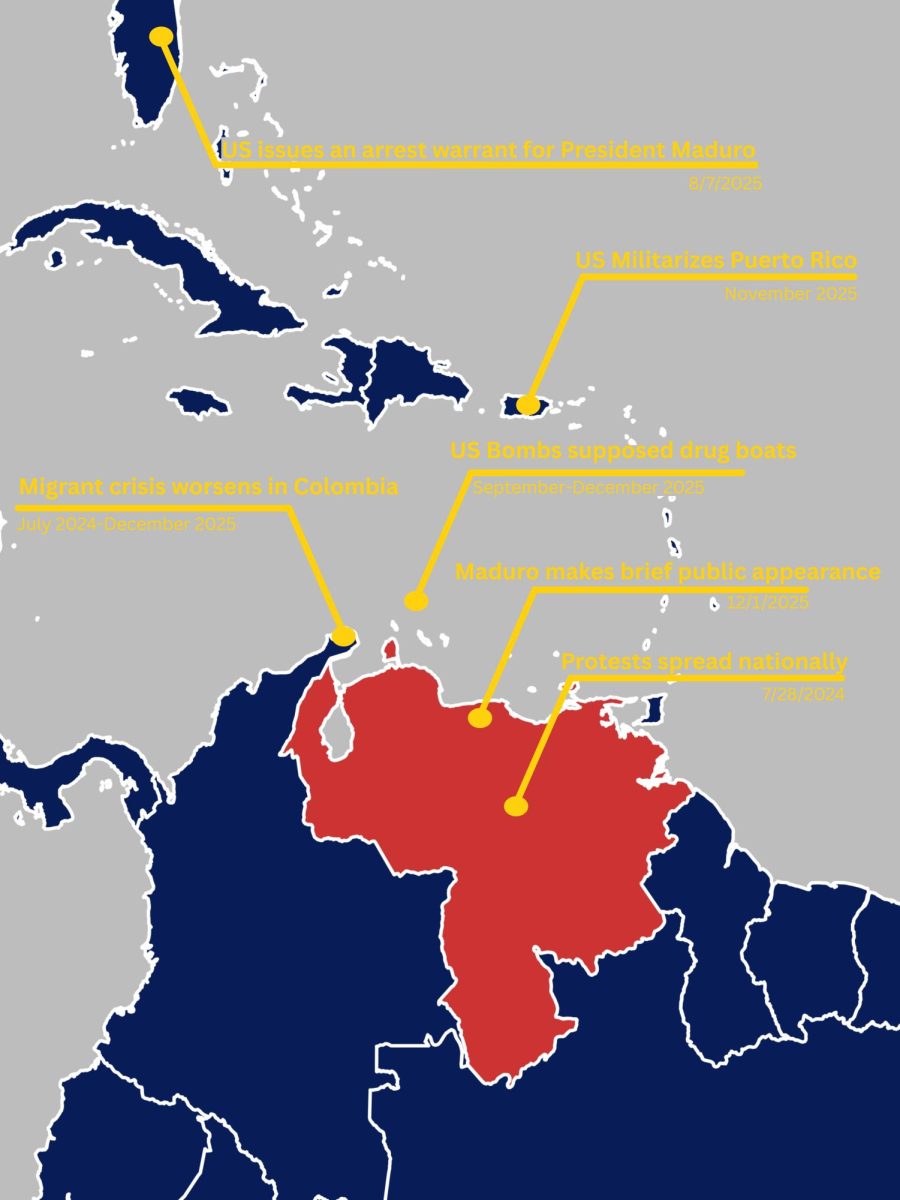
As of late, the Trump Administration has drawn a hard stance on what many officials in Washington have been calling “narco-terrorism,” a breed of violence and intimidation used by drug traffickers to shape government action. On Nov. 16, the Department of State declared that Maduro, and many other Venezuelan government officials, were to be designated as terrorists. This accompanied an arrest warrant against Maduro by the Drug Enforcement Administration, issued August of 2025.
For weeks leading up to this designation, the US military has been conducting controversial actions off the Venezuelan coast, and the military has continued to build a presence in the Caribbean including in Puerto Rico, a nearby US territory. Since Sept. 2, the U.S. military has carried out 21 deadly bombings of boats in the southern Caribbean, according to NBC.
In a statement on Oct. 31, UN Human Rights High Commissioner Volker Türk expressed contempt for American actions near Venezuela.
“These attacks – and their mounting human cost – are unacceptable,” Türk said. “The US must take all measures necessary to prevent the extrajudicial killing of people aboard these boats, whatever the criminal conduct alleged against them.”
On Dec. 2, Secretary of Defense Pete Hegseth was intensely scrutinized for saying “kill them all,” in reference to his orders to shoot at survivors of US boat strikes. Senator Rand Paul (R-KY.) equated these bombings to extrajudicial executions.
“They summarily execute people without presenting evidence to the public,” Paul said.
On Dec. 4, articles of impeachment were introduced against Hegseth by house Democrats as a response to his actions in the Caribbean.
Secretary of State Marco Rubio outlined the broader U.S. stance toward Caracas.
“Neither Maduro nor his cronies represent Venezuela’s legitimate government,” Rubio said in a Nov. 16 press conference.
Washington’s refusal to recognize the Maduro government has its roots in the 2024 Venezuelan Presidential Election, when Maduro won a third term as president. This election was notably contested as Maduro’s main challenger, María Corina Machado, was blocked from running by the country’s supreme court. She was then replaced by Edmundo González Urrutia, who was noted to have been extremely popular in the polls.
When it was announced that Maduro had been victorious, thousands of Venezuelans took to the streets. Police intervention commenced and 24 protesters and bystanders were killed, along with one security official, according to Human Rights Watch.
This violence played a key role in accelerating emigration from Venezuela, which had already been reaching high levels before the turmoil of 2024. The Venezuelan Refugee Crisis, an ongoing exodus from the country, has seen 7.9 million people flee Venezuela since the start of the crisis in 1999, according to the UN Refugee Agency. This has contributed to a migrant crisis in neighboring Colombia, the first destination for many Venezuelan emigrants.
According to the Department of Homeland Security, Venezuelan immigrants make up 11 percent of refugees coming into the US, with the number of Venezuelan immigrants in 2024 being 11,350, which is 71 times the number seen in 2022. Colorado has a population of over 9,500 Venezuelans, making up 0.2 percent of the state population. This does not include people who have immigrated here since the 2020 census, which is expected to significantly increase the number.
With recent actions towards Venezuela being hostile and violent, coupled with ICE raids often focused on Latino communities, many Venezuelans in the U.S. and Colorado are fearing for the future.
For some students, home is not just a place. It is a memory, a feeling, a voice across the phone that sometimes fades into silence.
For Venezuelan students at Creek, life in the U.S. continues, but their hearts often remain elsewhere.
“It’s like carrying grief in your chest every day. I feel guilt for being safe here, and rage that they’re not,” said junior Jordan Green, whose name has been changed to remain anonymous.
That grief is not always visible. It hides behind completed assignments, smiles, and hanging out with peers. Grief appears when you least expect it, most such as in moments of reflection, right before sleep, and in the sudden reminders of what was left behind.
Between adapting to a new culture and navigating school, these students carry the weight of separation from family, friends, and familiar places. For them, ordinary moments a shared meal, crowded streets, and the sound of music, now live only in memory.
For senior Sneyder Rangel, what he misses most is the sense of belonging.
“I remember a sense of community. People were very close, the streets full of life, the food, the festivities,” Rangel said. “It’s hard to be far away and not be able to help as much as I would like.”
He does not just miss a country. He misses the rhythm of everyday life, where neighbors felt like family and celebrations brought entire communities together. The memories are vivid but distant. There are snapshots caught in time.
Other students share the same quiet struggle. Some left friends behind. Some continue to worry about family members. Others are still adjusting to a reality that feels unfamiliar and temporary.
Yet, they continue. They show up every morning. They attend class. They plan for the future. They adapt to a new language, a new environment, and a new life. In doing so, they demonstrate resilience shaped by loss.
“It’s not that we forget where we came from,” Green said. “It’s just that we’re learning how to live with it.”
That balance of remembering while moving forward defines their everyday reality. They live between two worlds: the one that shaped them and the one that is shaping who they are becoming.
For many, Venezuela is not just a memory. It is a presence that follows them through the school hallways, through conversations, through dreams.
And though they may be far from home, they carry it with them every day.
“It’s very hard to be far away and not be able to help as much as I would like. Seeing family fight for basic necessities affects me a lot,” Rangel said.“It brings sadness, frustration, and a constant feeling of extreme worry.”