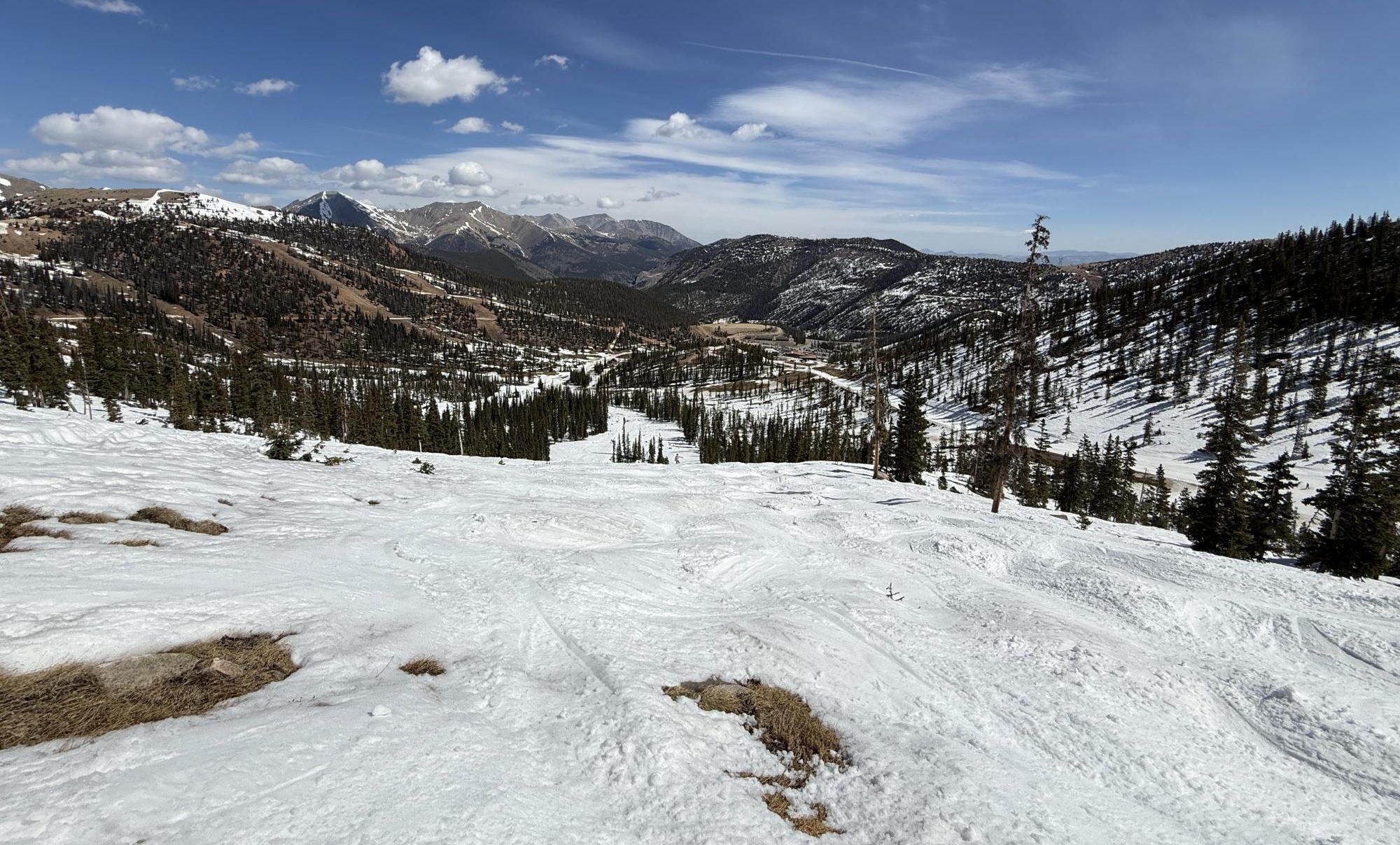

Many skiers and snowboarders will go to extremes to find the best ski conditions. They’ll buy passes that cost thousands, they’ll rent or buy expensive gear. They’ll take long road trips or buy plane tickets to get to the mountains. The most dedicated in the community give everything to find powder. But this year, Colorado had no answers for them.
Until recently, this was Colorado’s worst snowpack winter on record. The recent May 5-6 storm that pushed it out of last place might have helped alleviate drought, but many ski areas had already closed—a consolation storm couldn’t reopen the slopes.
“Kind of feels like I wasted my pass,” said senior Jace Palmer, an Epic Pass holder who skis Keystone and Breckenridge. “You bought this really expensive pass and you never really got to go up. The best day was after a random snow in early March, and there was only a few inches.”
What’s the culprit for Colorado’s poor snowpack? More importantly, who is affected moving forward?
What caused the season’s poor conditions
The most direct cause of the 2025-26 lack of snowfall was La Niña, a phenomenon that occurs in the Pacific Ocean but can have effects across the continental U.S.
La Niña, according to the National Weather Service, happens when an expanse of water in the equatorial Pacific becomes cooler than usual. A DU paleoclimatologist says that when it occurs, it creates a “ridge” of high pressure in the atmosphere, steering storms farther east.
“The wind patterns can have such a major effect on climate in general,” environmental science teacher Nicole Worden said.

There was a La Niña this year, but it wasn’t particularly strong. Sometimes “Super La Niñas” can occur; but this wasn’t one. But other factors amplified its effects.
Human-caused climate change is the chief cause of low snowpack. It doesn’t just raise average temperatures, it makes significant weather events like floods, droughts, and blizzards more extreme. And in the Rocky Mountain states, it’s driving a long-term decline in average snowpack.
With climate changing, skiers and boarders are migrating to new regions, according to CSU environmental historian Mike Childers.
“When you look at national numbers, you already see climate change adversely affecting [ski] places in the Northeast. Numbers are migrating to the Colorado and Utah Rockies, and that’s because we just get better snow because of where they sit on the continent,” Childers said. “But as climate changes, and you have more variance than that, those numbers are going to become less and less stable.”
Other causes include the chinook winds. As a high pressure system in the West and a low pressure system in the East cause major airflow over the mountains, these warm, dry gusts keep moist air far from the ground, according to OpenSnow.

Crucially, a lack of snowfall also kept the ground warmer, which made even more difficult for new snow to stick.
Many mountains will try to postpone closing with artificial snowmaking. This process, using powerful cannons, can supplement natural snow, extending ski seasons in both autumn and spring. But it uses huge amounts of water, and many ski resorts focus their snowmaking efforts on the most popular slopes—green and blue groomers that attract the most beginner and intermediate skiers and boarders.
“The real problem [with] snowmaking this year was twofold, temperatures…never got below the dew point to make snow…And then when it did get cold enough, ski resorts used up all their water,” Childers said. “You can’t really engineer your way out of that. Water freezes at a certain point…that’s a hard line that they just can’t cross over.”
Many skiers and snowboarders have united to advocate for climate policy. Protect Our Winters (POW) is an organization that partners with athletes like halfpipe snowboarder Bea Kim and cross-country skier Gus Schumacher.
“If being unable to ski and board is a motivating factor for people to support…fighting against global warming and climate change, it’s a good thing to use,” senior Parker Poticha said.
How the mountain economies were affected
Childers is an expert in Colorado’s relationship with snow. His 2012 book “Colorado Powder Keg” analyzed how the popularity of the state’s winter tourism has made the mountains highly valuable pieces of land when they’re snowy. He also studies how Colorado is affected when they’re not.
“Alpine skiing is the major draw and it’s simple math, when there’s no snow, people don’t go skiing,” Childers said. “And that has profound impacts on everything from lodging to ski rentals to restaurants to t-shirt shops, breweries.”
According to POWDER Magazine, a publication that focuses on resort news, avalanche conditions, and equipment reviews, almost every top ski resort in Colorado closed early this year.
In low-snow seasons like 2025-26, backcountry areas like Vail’s Blue Sky Basin or Winter Park’s Parsenn Bowl remain closed for much or all of the season because snowmaking has its limitations.
Those areas attract many longtime skiers, the people quickest to buy Ikon or Epic passes that give season-long access to many mountains in Colorado and around the world. But according to Childers, the lack of snow affects those consumers far more than the resort owners.
“One of the things that’s really interesting about the Ikon and Epic passes [is] that these are economic adaptations to climate change, like they’re getting their money now through October, before a single flake hits the ground,” he said.

Of course, skiers can also buy single-day passes during the season. But because of the poor conditions, these passes were in lower demand this year, directly affecting the resorts. Poticha saw this firsthand at Loveland Ski Area, where he’s a volunteer ski patroller.
“There were projects that we wanted to do over the summer that are now going to have to be delayed at least a year or more because we don’t have as much money,” Poticha said. “We had to budget ourselves a little more because the profits were lower, we closed…weekends sooner than we normally would want to.”
Mountain towns and businesses might not be able to stomach the losses as well as big mountains, though. While the locals might enjoy quieter weekends and fewer crowds, the seasonal workers won’t feel the same.
“A lot of the mountain communities have based their entire economy around tourism, and for the winter that’s skiing,” Childers said. “Some folks who are working within the service industry just lost their jobs and couldn’t afford their rent, and so they had to move on.”
Palmer’s grandfather and father, Gary and Joel Palmer, run Altitude Adjustment, a small business that sells a dietary supplement meant to help with altitude sickness and the symptoms it comes with, like nausea.
“I know that this year was really rough for those little businesses that sell the stuff geared towards skiing,” Jace Palmer said. “It felt like the whole year was a slow season.”
Meanwhile, on the mountain, Poticha had to work harder because fewer volunteer ski patrollers worked hours this season. He actually noticed the slopes were safer, though.
“Because of the way the snow was, there’s just less people on the mountain in general, which decreases your chance for injury,” he said. “And…less beginners because they weren’t as motivated to learn how in a bad season, because it’s just not as enjoyable.”
Climate implications of a low-precipitation winter
Snowpack isn’t just about winter tourism. When all that snow goes away, it becomes essential for daily life, agricultural work, and infrastructure throughout the Front Range and beyond.
“We get our drinking water from the snow melt, so it’s really important for us to have that,” Worden said. “So we’re going to have some serious water restrictions.”
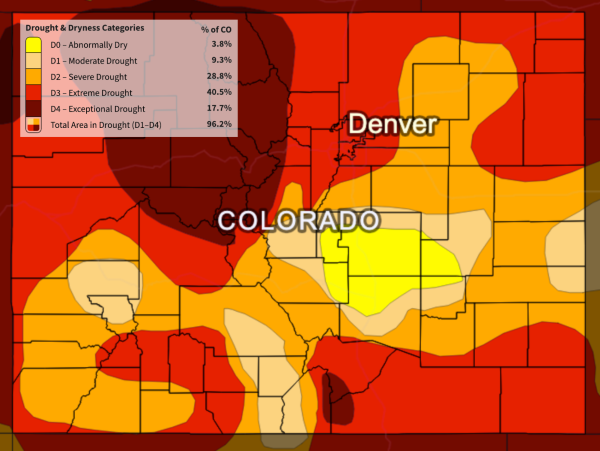
Denver declared a Stage 1 drought on March 25. As of May 10, almost all of Colorado is at a Level 1-5 drought on the U.S. Drought Monitor (Stages refer to local water usage restrictions, Levels refer to the nationally-used classification).
Stage 1 drought restrictions are limited to outdoor uses: hoses and sprinklers. The point is to reduce water usage by 20% to limit the probability of greater restrictions later in the summer. Stage 2 moves to outright bans on outdoor usage, and Stage 3 means water rationing, affecting our daily lives, including showers, dishwashing, and laundry.
“[This Stage 1 drought is] nothing majorly serious, but it is concerning…because we get all of the water from the mountains,” Worden said. “All that snow melt goes into our reservoirs down here, and so that when we don’t have that snow, our reservoir levels get really, really low.”
Drought also spells fire danger for the summer. According to the Colorado Trails Foundation, forest fires are the “#1 concern for summer 2026.”

“You won’t see anybody being able to do any types of camping fires, or even cooking, barbecuing and things like that,” Worden said. “Because just a tiny little spark when it’s dry, you can’t take any chances. So yeah, that would definitely have an impact on recreation.”
Only the recent May 5-6 storm pulled 2025-26 out of last place in recorded historical snowpack. The only worse year on record now is 1976-77, dubbed the “year of no snow.”
“I’m worried about what’s going to happen next,” Childers said. “So what’s it gonna look like in August? The implications of not having water really scare me.”
Impacts on ski culture moving forward
Childers and Palmer don’t think this year are significant hits to Colorado’s ski business; every once in a while, there’s a down season.
“I don’t think in the short term it’s going to change a whole lot. People still love to ski,” Childers said. “But if we continue to see trends like this for seasons like this, or even slightly better seasons, you’re going to see skier numbers decline.”
Palmer has seen optimism and resourcefulness in ski culture.
“I feel like I saw more back country skiing this year, more people trying to get the most out of what was there, without having to worry about what was closed and stuff on mountains,” he said.
And while ski season passes might be designed to protect the big resort companies from climate change, seasons like these make skiers rethink their spending.
“We spent a lot of money and did not get any return on it, and then felt a little let down by Alterra and Vail resorts not giving us any sort of love for a missed season,” Childers said. “So the people are reassessing how much they are going to be willing to pay.”

(Peter Philpott)