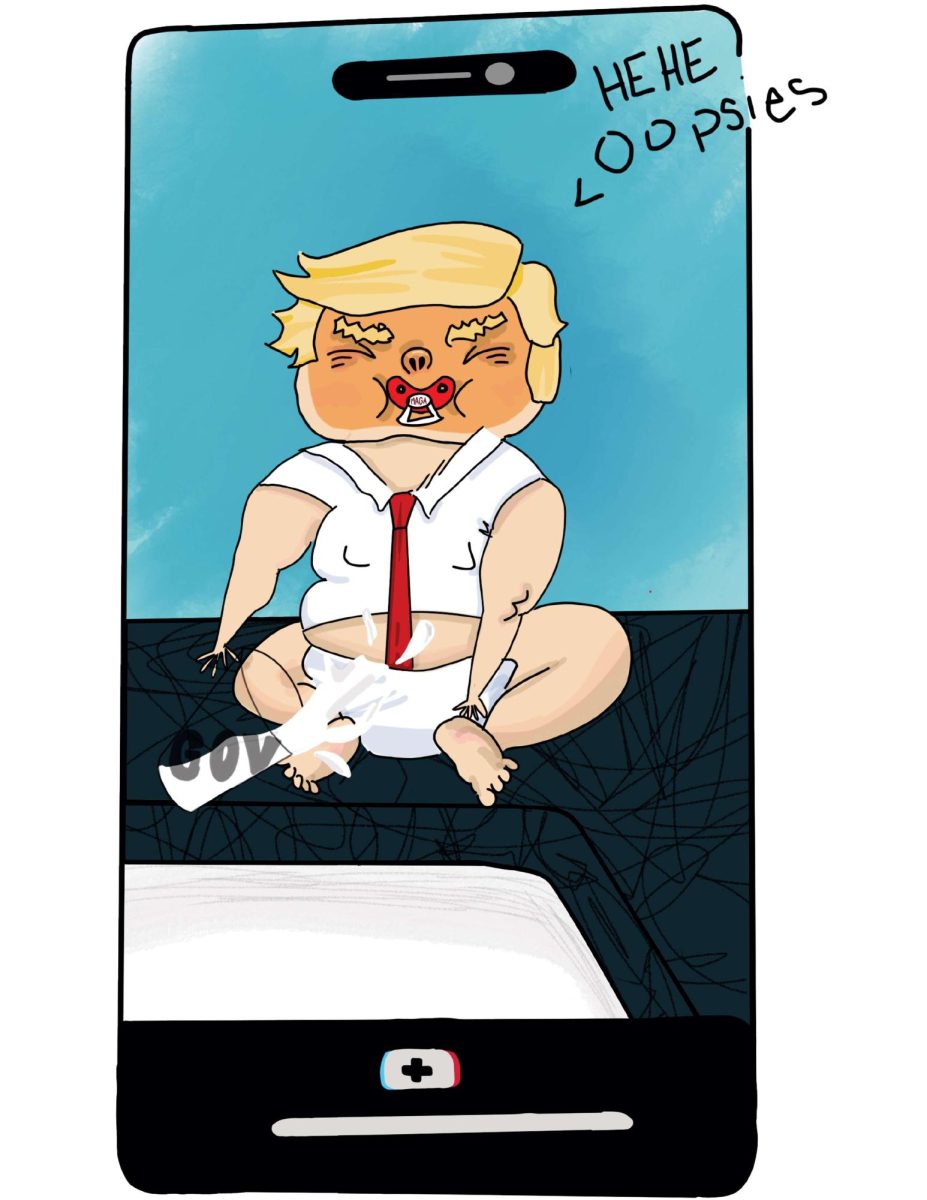
Social media allows for news to be spread quickly, and oftentimes humorously.
While it’s not necessarily harmful if a politician does something that makes us laugh, it becomes harmful when serious actions are shown as jokes with minimal information.
“That kind of stuff gets re-broadcast across social media a lot, which I think he likes, because I think Trump likes any media attention,” social studies teacher Tim Kirkpatrick said. “I think it draws away from the issues, which is what I wish Americans were more focused on.”
Seeing those attention grabbing videos on sites like TikTok or Instagram doesn’t educate us about things going on in the world. Many popular political accounts follow trends to make fun of Trump, saying he’s bad but giving zero explanation as to why. You see the clip and you’ll scroll and form an opinion. You likely won’t do a quick Google search to learn about what he is really doing. This black and white persuasion promotes bias and splits us further apart.
“Now that’s the headline news, or that’s what you’re seeing on social media, I don’t think that benefits our political system,” Kirkpatrick said.
Trump is a great example of this tribalism and hilarity that is problematic. He has been in the eye of the media for a long time, having previously been on reality TV and now being the topic of many controversies. These controversies have become a joke. His MAGA people adore him and don’t care about his felonies, perverted remarks, or backwards views on minorities.
“I don’t think people go beyond it and say, ‘how is he going to make America great?’” Kirkpatrick said.
Many like him because of his contentious personality. They like that he is unpredictable and bizarre. Since people are so confined to their parties, many would rather stick with an extreme person from their party – in this case the Republican Party – than support a mediocre person from another party.
There is an opposing team that thinks he’s a moron. But because they only see the joke videos of how terrible he is, no one is surprised anymore with whatever new controversy arises. Rather than being outraged, people are simply expecting the worst. Trump happens to be on the conservative side, but either ideology could get stuck in a cult following because of the continued separation.
“If someone like Gavin Newsom rises to the level of popularity among democrats that Trump experienced among republicans, I think democrats would do the exact same thing,” social studies teacher Fletcher Woolsey said.
California governor Gavin Newsom has exhibited similar extremities in the sense of being comical and abrupt. He calls out Trump by mocking him rather than straight up educating people about problems with Trump. Fighting fire with fire won’t extinguish it, rather, it’ll create a larger fire.
Even if the goal is to educate while being satirical, it creates the same problem of tribalism. It gives him that loyal following and makes people like him, not necessarily because of actual policies, but because he is charming. It, again, divides people and stops us from looking at real news sources that are credible, and forming their own opinions. Personality has overtaken policy.
“[Social media] has made politicians more concerned with popularity,” Woolsey said. “Looking for the opportunity to say the next big thing or generate the most conversation, no matter how ridiculous or controversial.”
This obsession with our politicians having such extreme personas makes us numb to news that should shock us.
“We’re a little tuned out as voters, or harder to shock at least,” Kirkpatrick said.
Seeing illegal things happening in our administration should make us uncomfortable. When we get used to joking around about our problems they become smaller. We won’t feel bad for the people whose lives are changed for the worse. When things don’t affect us and we laugh about them, we stop caring for the people they do affect.
We lose empathy.
That is the result of these jokes. That is why this is damaging. There is nothing wrong with laughing at something messed up, but when that is every single bit of news we look at, then it’s an issue.
“You see it, you see it, you see it, and you just kinda go, ‘eh’,” Kirkpatrick said.