

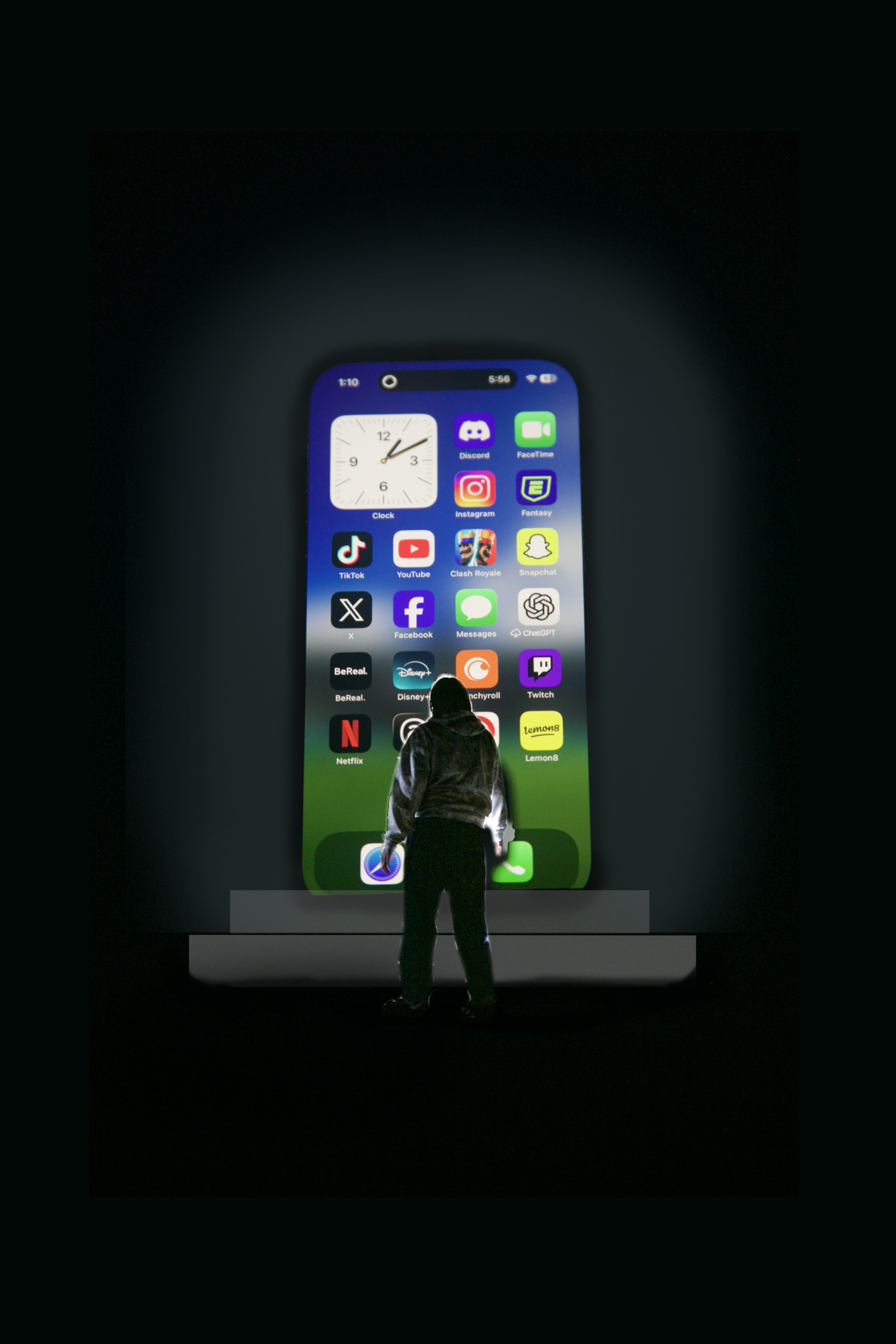
The smartphone is the greatest innovation of personal tech humans have ever devised. These small, portable devices have become a multitasker’s tool in so many ways. When they were first introduced, they were a revolutionary vehicle for simple actions like calling, texting, and surfing the web. Now, they’ve grown into almost full replacements for our computers, our cameras, our navigation, our flashlights, and our .mp3 players.
Yet these devices, with their ever-brighter screens and vibrant colors, have served as a perfect platform for social and content apps to take over. Phones have been the conduit for short-form video content, making TikToks, Instagram Reels, and YouTube Shorts the center of the teen “doomscrolling” phenomenon. Smartphones are undoubtedly one of the most innovative developments of the 21st century. But are they dangerous? Are the distracting apps and the clickbait headlines and time-sucking video games they carry too distracting?
“It’s a defining epidemic, and it will be the defining challenge of your generation, on how to respond to technology use and overuse,” said Hailey Wright, the Project Reboot Head of Educational Partnerships. “There’s an issue beyond Gen Z as well and all mannerisms. We are all in some shape, way or form, addicted to our devices.”
Project Reboot is a ‘digital wellness company’ that works with students to find a healthy relationship with devices. On Oct. 28, Project Reboot founder Dino Ambrosi came to Creek to speak to all students about that mission and tools to fight addiction. Wright works with schools like Creek to bring the company’s message to students nationwide.
Do those students agree? Sophomore Peter Rasmussen used the assembly as an opportunity to change his own habits.
“There’s a level that’s scientifically proven to be healthier,” Rasmussen said. “I’d say the vast majority of people with the phone are way above that right now, including myself. I would say we do have a problem.”
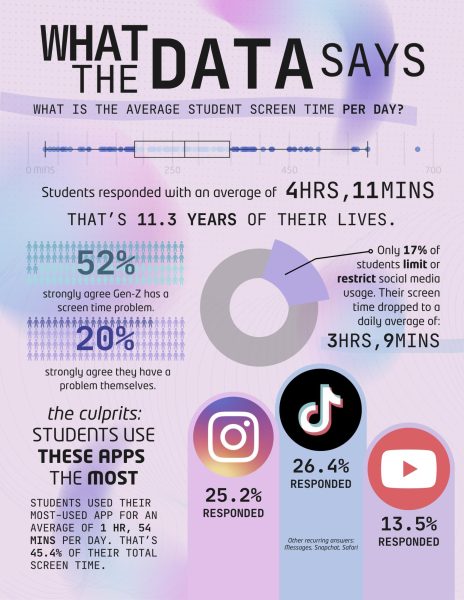
Yet despite this “epidemic,” Creek students spend less than the national average on their phones, by a large margin. Teens nationwide average six hours and 36 minutes; Creek students average four hours and 11 minutes during a school week, according to a poll of 163 students. But Wright still sees this as an issue; to her, it matters less the quantity of time spent on a phone, more so how one spends that time.
“You can be doomscrolling for two hours a day, and it’s still a hindrance to you,” she said. “You can be doing a research project, on your phone, and be using it for four hours a day, and [that’s] good. So it’s all a balance of how you are using it, not necessarily how much you are using it.”
Several shifts in smartphone culture have pushed an increase in teen screen time. 69 percent of kids have a phone by age 12. From 2014, The percentage of teens using social media apps have ballooned: teens using Instagram has increased 17.3 percent; Snapchat saw a 34.2 percent increase; TikTok is still a fairly new app, popularized in 2018. 63 percent of teens already use it.
“It’s designed to be addictive,” Wright said. “It’s designed to be habit seeking, and it’s really hard to break those habits.”
Rasmussen says those apps have a second damaging effect, on top of taking up time.
“I’d say it really reduces your attention span,” he said. “I think the biggest issue is it just disables you from doing other things productive outside of the screen time. It just really puts you in the wrong headspace.”
Even with improvements he’s made to reduce doomscrolling since the Project Reboot assembly, Rasmussen still thinks he has work to do to get off his phone. Wright says that this self awareness is where to start.
“Yes, teens have a problem…I believe that we are at a pivotal moment,” she said. “I think most kids know that they are highly addicted…They just don’t know exactly how to fix it.”